
How to teach reading comprehension skills explicitly to struggling readers
READING COMPREHENSION INTERVENTION COURSE DUO Lulu and Toetoe
Teach struggling readers to understand what they read, starting at the very beginning.
Reading comprehension is one of the biggest challenges in classrooms today. Created by Educational Psychologist Annemarie Roux, this programme answers the question so many teachers ask: where do I start, how do I teach, and where do I find the right resources?
This course offers training and guidance on how to teach reading comprehension, plus specialised, differentiated resources to implement in your classroom straight away.
Through the playful Lulu and Toetoe characters, an adorable duo, you learn how to build understanding, vocabulary and confidence one story at a time. The programme comes in differentiated levels, so children meet the story at the level they can manage and grow from there.
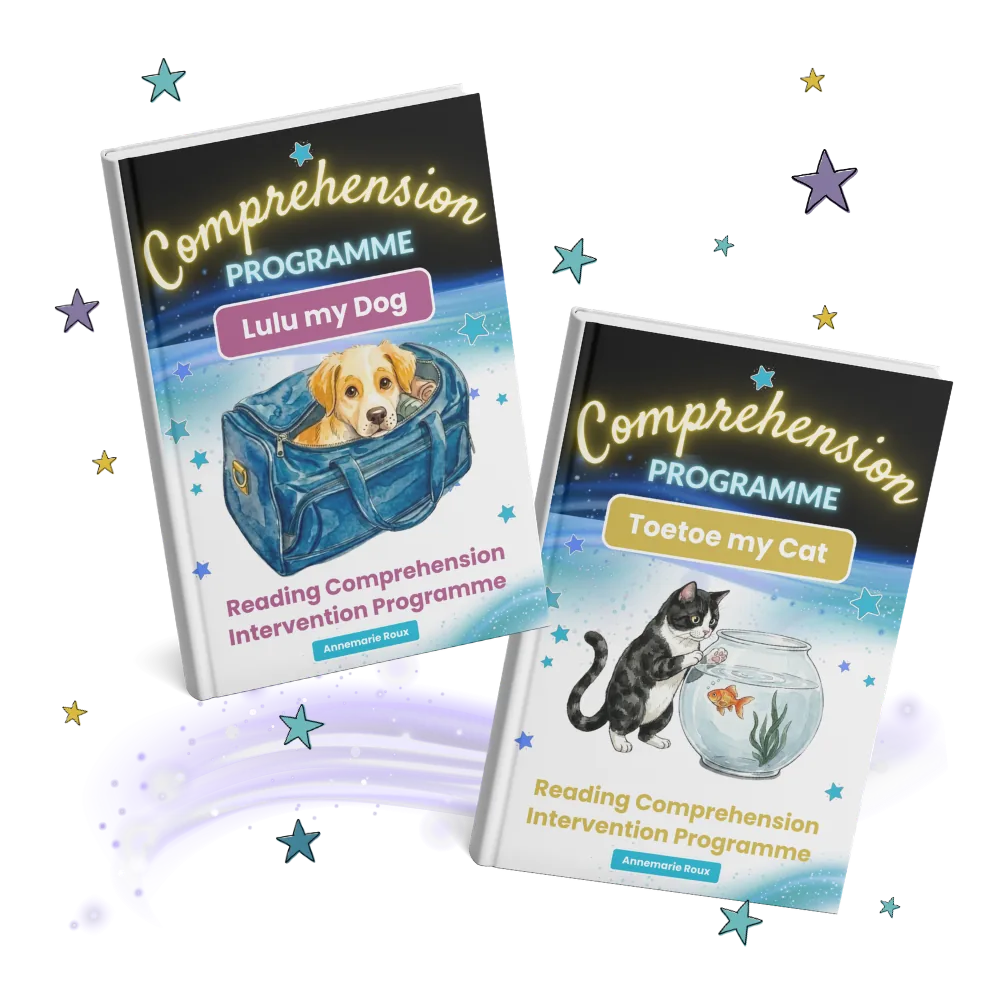
*The binding shown in the mockup is illustrative only. Programmes are ring-bound at the in-person training, and supplied as PDF downloads in the online course for you to print and bind as you prefer.
TWO WAYS TO LEARN Workshops or Online
The same programme, two ways to learn it. Study online in your own time, or join Annemarie in person for a hands-on morning with fellow teachers.
Online course
Learn at Your Own Pace
- Start any Time, from Anywhere
- Annemarie Walks you Page by Page with Engaging Video Lessons
- Rewatch any Lesson
- All Picture Cards, Sentence Cards and Domino Games are Available as Downloadable PDF Files
- Certificate of Attendance
In-person workshop
In-person Workshops - Durbanville
- Half-day Morning workshop - In-person
- Experience the Fun of Learning Through Play
- Two Full-colour Printed, Ring-bound Manuals
- Lunch, Coffee/Tea and Refreshment
- Certificate of Attendance
WHO IT IS FOR Developed for Educators
- Teachers: whose readers can decode the words but lose the meaning of what they read.
- Remedial and learning support educators: looking for a structured comprehension programme.
- Therapists and Tutors: who want a story-led way to teach comprehension skills.
- Homeschooling parents: supporting a child who reads without understanding.
- Anyone supporting older learners or English second-language readers who need to start at a lower level.
ADVANTAGES What makes this training Special
How to run the programme as a reading intervention, not a worksheet
How to use differentiated levels to meet a child where they are
How to build vocabulary through a story
How to grow a reader’s confidence with each story they understand
How to use every resource in the programme in your classroom
WHY IT WORKS A two-pronged Approach
Training: Gain the knowledge and skills to teach children with reading comprehension difficulties.
Resources: Specialised, ready-to-use, fun and differentiated material, saving you hours of preparation.
“Find the functioning level of the child and start there, even a level lower, so the child experiences success and believes: I can read!”Annemarie Roux
Grounded in the Science of Reading
Every component of the Science of Reading forms part of this intervention programme - as illustrated in our Rouxi Literacy Tree.
This is not a curriculum. There is no fixed pace or timetable: the child's needs are at the centre and readers progress in their own way and at their own pace.
READING COMPREHENSION LEVELS Four levels, One Journey
Levels are set by reading ability, not age or grade.
Level 1
Emergent Reader
CAPS Grade R / Foundation Phase entryNo text yet. Listening, oral vocabulary and background knowledge through seven playful steps: Let's Talk moments, modelled reading, echo talking, picture cards, storytelling, I-Spy and listening games.
Level 2
Beginner Reader
CAPS Grade 1, Terms 1–2First text. Short sentence cards with matching pictures, high-frequency and CVC words, lots of repetition, and the Level 2 domino game.
Level 3
Developing Reader
CAPS Grade 2 mid-year – Grade 3Reading phrases rather than word by word, self-correcting and reading sentences without support, consolidated through play.
Level 4
Flying Solo
Growing independenceMatching, reading and playing at a higher level, ending with students reading the story on their own, without any support.